
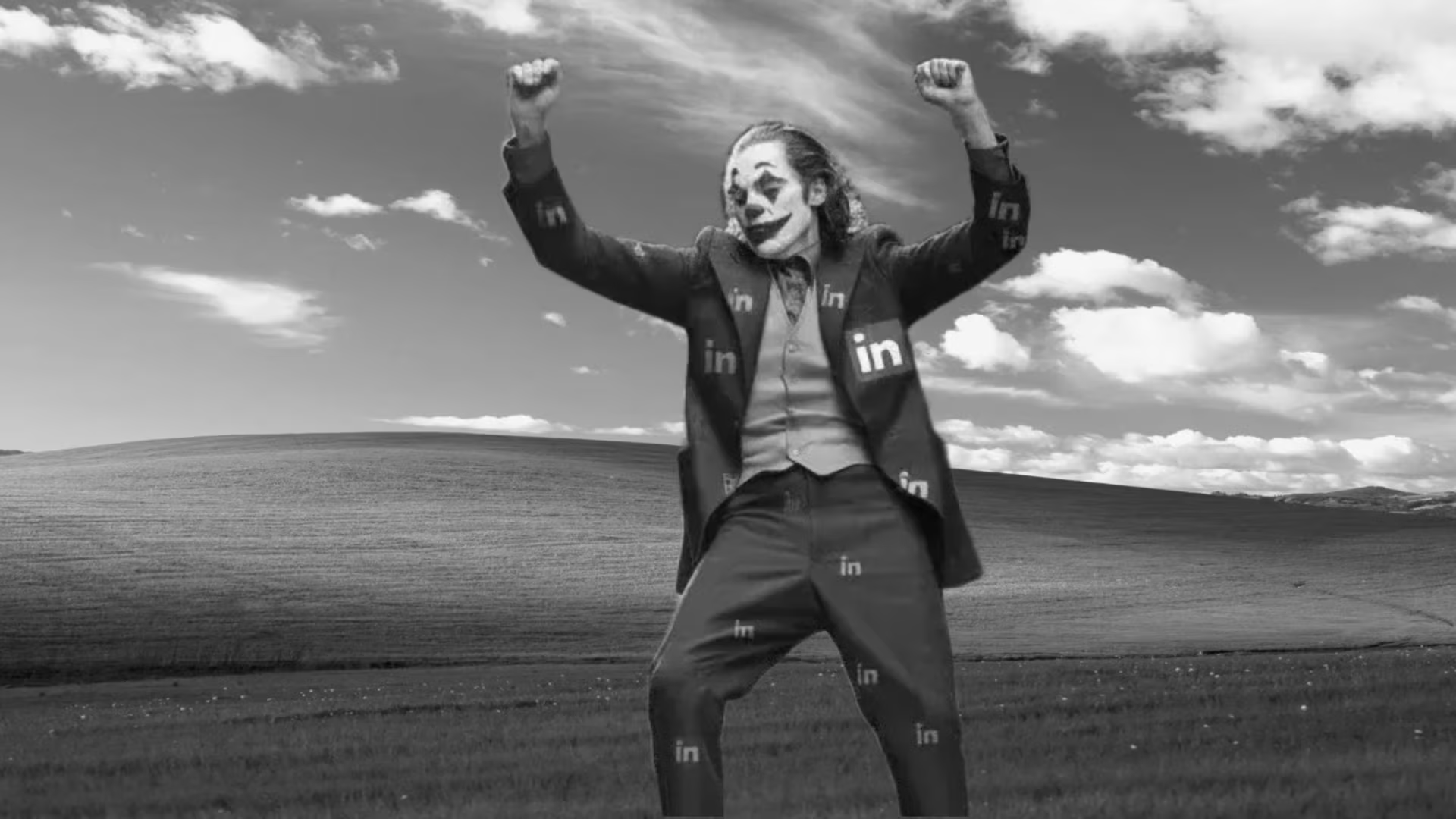
A few weeks ago I read a LinkedIn post by someone I vaguely know. It was lovely. The kind of writing that makes you sit up a little. Sentences that turned at the right places. A metaphor that did some real work. I read it twice, which is rare for that platform. Then I scrolled to the comments and found him, in the replies, agreeing with himself in a slightly different voice. The post had the rhythm of a poet. The replies had the cadence of a man who orders his coffee with extra sugar. Same brain, two registers. One of them, I’m fairly sure, was not his.
This is not a piece about AI being bad. AI is not bad. A hammer is not bad. What I want to talk about is something smaller and meaner, something that has been quietly spreading for a while now, and which seems to bother almost nobody.
It’s been long. There is so much AI generated writing floating around now that it’s becoming the wallpaper. Some of it is staggering. Pulitzer grade prose drafted in eleven seconds. Lines so well wrought you suspect Marquez has been quietly resurrected and is moonlighting for a content marketing agency. And yet, almost without exception, these pieces have the same odd quality. They are perfect, and they are empty. Beautiful corpses. You read them and feel the way you feel walking through a hotel lobby at three in the morning. Every surface is gleaming. Nobody is home.
So here is the thing I want to say plainly, because the polite version of it has not done any work. Using AI to write something is not the dishonest part. Pretending the thing it produced is your opinion is. That is the small, slithery dishonesty almost nobody is owning up to. The piece you posted, the one your friends are calling thoughtful, that beautifully phrased meditation on grief or capitalism or the death of the third place, was generated by a statistical model trained on the entire internet’s averages. You read it once. You agreed with it. You hit publish. Somewhere between those three actions a person was supposed to show up, and didn’t.
What is an opinion, anyway. I don’t think we use the word carefully enough. An opinion is not a position you happened to encounter and didn’t object to. It is something that survived contact with you. You read three things that disagreed with each other. You sat with the one that made you angry. You found out, two days later in the shower, that the angry one was right and you didn’t want it to be. You changed your mind. You changed it back. You wrote a sentence and crossed it out because it sounded better than you actually felt. That sediment, that slow accumulation of friction and revision and small embarrassments, is what makes a thought yours. None of it happens in the four seconds between a prompt and a paste.
There is a particular flavor of laziness at work here that I find more interesting than the obvious one. The obvious laziness is asking a model to write the thing for you. Fine. We’ve all done worse for less. The deeper laziness is not even reading what it produced with any seriousness. Not stopping at the line that doesn’t quite ring true. Not striking the metaphor that’s vaguely off. Not noticing that the third paragraph is making a claim you would never actually defend at a dinner table. The model is fluent and you are tired, and fluency is hypnotic when you are tired, so you let it pass. You agree to the opinion the way one agrees to terms and conditions.
And here is the strange consequence. Language models are, by design, machines for producing the average. They are trained to predict what comes next based on what most people, most of the time, have already said. So when you publish their output unedited, what you are putting your name to is not just somebody else’s writing. It is the median of all writing. You are signing the consensus. The thing you are passing off as your distinctive voice is, almost by definition, the least distinctive thing on offer. It is the sound of everyone, attributed to one.
I think a lot about a small moment in the actual act of writing. The moment you reach for a word and the word you reach for is wrong, and you know it’s wrong, and you sit there for ninety seconds trying to find the right one, and you can’t, so you settle for the second best one, and three days later stuck in traffic on Outer Ring Road the right word finally arrives and you almost rear end the car in front of you. That whole humiliating, lovely process is what writing is. It is also, not coincidentally, what thinking is. You don’t get to that word by accepting a draft. You get there by having tried and failed to write the sentence yourself first.
None of this is an argument against the tool. Use the tool. Use it to draft, to brainstorm, to break a block, to find a structure, to compress something bloated, to expand something thin. All of that is fair, and frankly all of it is interesting. Where it gets dishonest is the small final step where you stop being a reader of your own work. Where you stop pushing back against the sentences. Where you abdicate the editor’s seat and become only the publisher, faster and faster, posting other people’s averages as your particular truth.
The funny thing is, the readers can tell. They cannot always articulate it, but something in them registers. They feel the lobby at three a.m. They scroll a little faster. They click “like” because the social grammar requires it, but nothing in the post stays with them the next morning. Soul, whatever else it is, is the thing that survives the next morning. The byline you’ve borrowed cannot give you that, because nothing was paid for it. There was no friction in the writing, so there is no friction in the reading.
I’m not interested in policing how anyone uses these tools. I am interested in a slightly smaller, more personal thing. The next time you post something you didn’t really write, ask whether you would still post it if you had to read it aloud, slowly, to someone whose opinion of you you actually cared about. If you wouldn’t, the problem isn’t the model. The problem is that somewhere along the way you stopped being willing to be the person whose name is on top.