
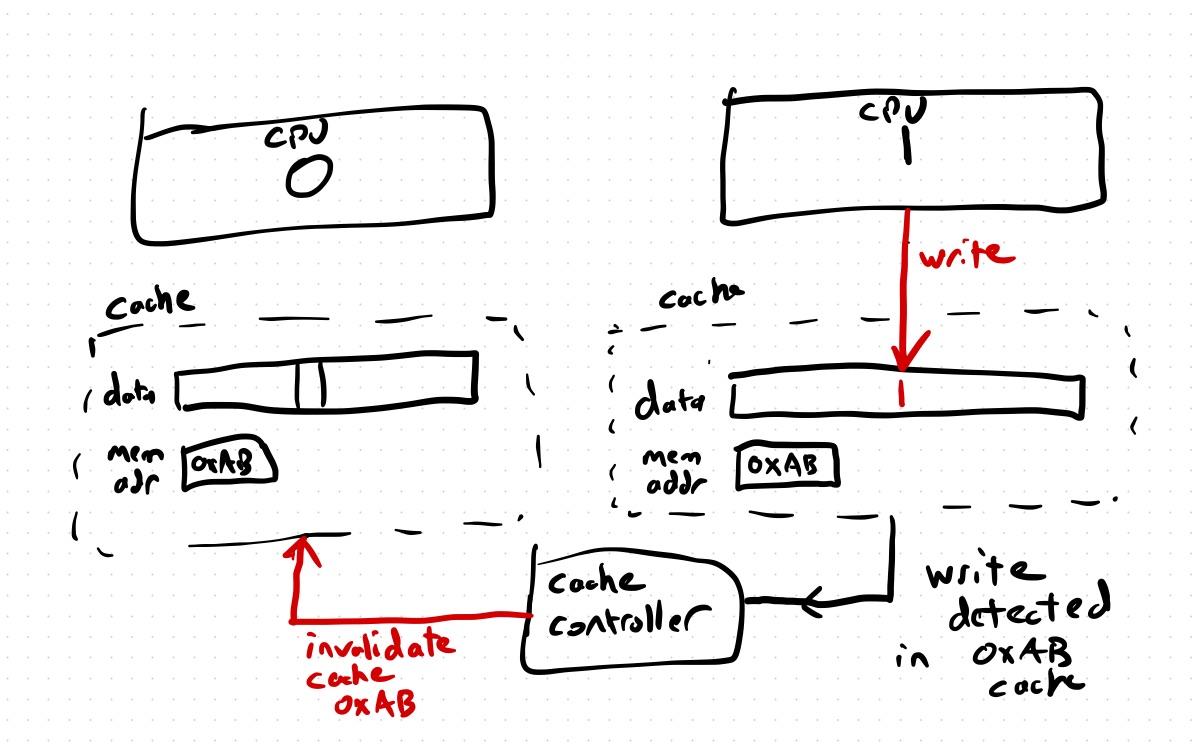
There is an old joke in software engineering. It goes: there are only two hard problems in computer science. Naming things, cache invalidation, and off-by-one errors.
You laugh. Then you sit with it for a second.
The one I want to talk about is the middle one. Cache invalidation. It is a problem so fundamental, so quietly persistent, that programmers have made peace with it the way fishermen make peace with the sea. You don’t solve it. You just learn its moods.
Here is what it means, stripped of jargon.
Imagine you run a website. Every time someone visits, the server has to look up data, do calculations, assemble a page, send it back. This is slow. So you cheat. You save a copy of the finished page somewhere fast, a cache, and the next visitor gets that copy without all the work. Brilliant. Until something changes. A user updates their profile picture. A price goes up. A blog post gets edited. Now the cache is wrong. It is serving the old version of reality.
And here is the cruel part. The cache does not know it is wrong. It feels perfectly confident. It is being absolutely right about a version of the world that no longer exists.
Knowing when to throw away cached data and go fetch the real thing again is what is called cache invalidation. It sounds simple. It is not. It is the source of more late-night production bugs, more “but it works on my machine,” more silent miscommunication between systems than almost anything else in computing.
And it is exactly how people fall out of love.
Think about your parents. Specifically, the way they still see you.
2009, while she was still alive, for my mother, somewhere underneath the adult I had become, there was still a six-year-old who needed to be reminded to eat. During my last year of college, she knew, intellectually, that I am twenty two-something and work in a part time job and pay my own taxes. But the cached version of me was still in there, and it popped up whenever she called. “Have you eaten?” was not really a question. It was a query to a database that has not been refreshed since 1996.
It was sweet. It was also a little sad. Because the real me, the one with insomnia and quiet anxieties she had never seen, never quite made it into her cache. She loved me, yes. But she loved a version of me that no longer fully existed, and she went on loving that version until she was gone, forever.
This is not her failure. It is everyone’s. We all do it.
The friend from college you haven’t seen in fifteen years still thinks you are the guy who once drank neat vodka and recited Madhushala by Harivansh Rai Bacchan in a parking lot. He is genuinely surprised when you mention you don’t drink anymore. His model of you was last updated in 2010.
The ex who left thinks of you as exactly who you were the day they walked out. They have not seen the struggles, the long walks, the changes that took root in you specifically because they left. In their head, you are frozen. Permanently the version of yourself that wasn’t enough.
And worse, that version of you in their head goes on living. It says things. It makes choices. It betrays them again, years after the fact, in arguments that play out in their imagination, even though the real you stopped being that person a long time ago.
This is what makes old grudges so unfair. You are not being judged by who you are. You are being judged by a cached pointer to who you used to be.
But the unfairness cuts both ways, and this is where it starts to hurt.
You also keep stale versions of the people in your life.
The version of your father in your head is probably the man from when you were twelve. He was tall, certain, occasionally terrifying, and seemed to know what he was doing. But the actual man, the one currently sitting on the sofa watching the news at unhealthy volume, is none of those things anymore. He is tired. He is sometimes unsure. He is sixty-something and quietly worried about things he will never tell you. You do not see this because your cache hasn’t refreshed in twenty years.
The version of your wife in your head is probably the woman you fell for all those years ago. The one with the specific laugh and the specific dreams and the specific way she looked at you across that table on date three. The current woman, the one who has anxieties, the one who has to adjust to your daily annoyances and quietly reorganised her entire interior life twice since you met her, gets to be unseen, because the cache is still serving the old page.
This is, I think, the slow violence at the heart of every long relationship. Not cruelty. Not even neglect. Just stale data.
You stop fetching. You assume you already know. And the person in front of you, who is changing in real time, becomes invisible behind the version of them you have been carrying around in your head.
We don’t fall out of love. We fall out of date.
In software, you fix this with something called cache invalidation strategies. Time-to-live values. Forced refreshes. Webhooks that ping the cache when reality changes. Whole architectures exist just to make sure stored copies of things stay close to the truth.
In life, the equivalents are unglamorous and obvious, and we are all bad at them.
Asking your spouse what they have been thinking about lately, and actually listening to the answer, is a cache refresh. Letting your parents see the parts of your life they wouldn’t naturally encounter is a cache refresh. Updating your own assessment of a friend after they say something that contradicts your model of them, instead of brushing it off because “that’s not really her,” is a cache refresh.
It is exhausting work. The whole reason caches exist in the first place is that going to the source every time is too expensive. You cannot live like every conversation with your mother is a full audit of who she has become this year. You would burn out. So you take shortcuts. You assume. You serve the old page.
The trick, the only one I have found, is to know that your cache is always at least partly lying to you. The person across the table is not quite the person you think you are talking to. They have moved. They are still moving. The version of them in your head is a snapshot. It was true once. It is less true now.
There is a line in Dostoevsky, somewhere in The Brothers Karamazov, where one character says that the more he loved humanity in general, the less he loved people in particular. I think about that line a lot. It is a warning about the danger of loving an abstraction instead of a specific, inconvenient, constantly changing human being.
To love someone is to agree to keep updating who you think they are. Forever. Without ever quite getting it right.
It is the hardest problem.
Phil Karlton was talking about software when he made that joke about cache invalidation. But I think the universe was using him to leak a memo.