
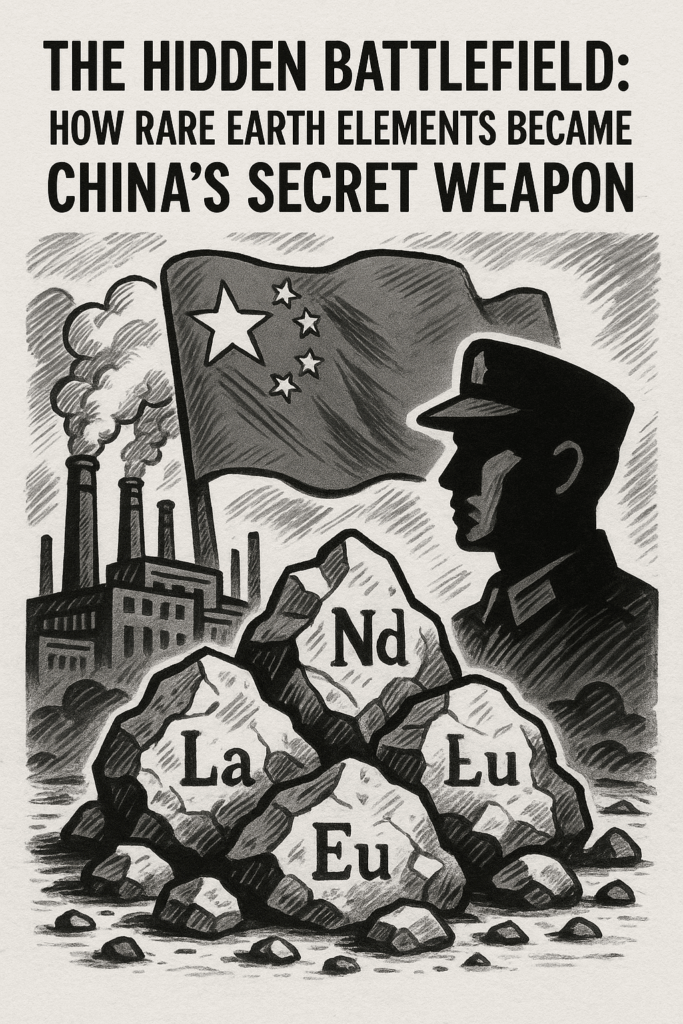
China just demonstrated it can bring American factories to their knees without firing a shot—by restricting exports of obscure metals most people have never heard of. In April 2025, Chinese export controls on seven rare earth elements triggered immediate production shutdowns at Ford plants, Tesla delays, and what industry insiders describe as “full panic” across global supply chains. This isn’t just another trade dispute; it’s a preview of how the most important geopolitical competition of our time will be fought with the periodic table as a weapon.
The stakes couldn’t be higher. These “rare earth elements” power everything from the iPhone in your pocket to the F-35 fighter jets defending American skies. China controls nearly 90% of the global processing capacity for these critical materials, giving Beijing unprecedented leverage over the technological foundation of modern civilization. While the US and China battle over semiconductors and artificial intelligence, China has been quietly tightening its grip on the elements that make all advanced technology possible.
This is the story of how 17 obscure elements from the bottom of the periodic table became the epicenter of a new kind of warfare—one where economic interdependence transforms into a weapon of coercion, and the future of American technological supremacy hangs in the balance.
The invisible foundation of everything
Walk through your home and try to find something that doesn’t contain rare earth elements. Your smartphone’s screen glows with europium and terbium creating perfect red and green colors. The tiny magnet that makes your phone vibrate contains neodymium and dysprosium. Your laptop’s hard drive spins on bearings with samarium-cobalt magnets. Even your car’s catalytic converter uses cerium to clean exhaust emissions.
Despite their intimidating name, rare earth elements aren’t actually rare—they’re scattered throughout Earth’s crust in tiny concentrations, making them expensive and environmentally challenging to extract. What makes these 17 metallic elements irreplaceable isn’t their scarcity, but their unique electron configurations that create extraordinary magnetic, optical, and electrical properties no other materials can match.
Consider dysprosium, the poster child for this invisible dependency. This silvery metal allows magnets to maintain their strength at high temperatures—a seemingly mundane property with profound implications. Tesla’s Model S uses dysprosium-enhanced magnets in its motor; without them, the magnets would fail when the motor heats up during acceleration. Each F-35 fighter jet contains 920 pounds of rare earth materials, with dysprosium critical for electronic warfare systems that must function reliably under extreme conditions.
The numbers reveal the scope of our dependence. A single 3-megawatt wind turbine contains up to 2 tons of rare earth permanent magnets. A Virginia-class submarine requires approximately 9,200 pounds of rare earth materials for propulsion systems, sonar arrays, and electronic warfare equipment. The clean energy transition Americans desperately want? It’s built on Chinese-controlled materials.
China’s stranglehold and strategic weaponization
China didn’t stumble into rare earth dominance—it systematically built an unassailable position through decades of strategic planning. While producing 70% of global rare earth mining, China controls 85-90% of the world’s processing capacity, the true chokepoint in the supply chain. Even American and Australian mines ship their raw materials to China for processing because alternatives simply don’t exist at scale.
This dominance extends to an almost complete monopoly over heavy rare earth elements like dysprosium and terbium, where China controls 99.8% of global production. These elements are essential for high-performance applications in defense systems and clean energy technology. Without them, America’s military advantage and clean energy goals become impossible to achieve.
Beijing has methodically transformed this market position into geopolitical leverage. In December 2024, China banned exports of gallium, germanium, and antimony to the United States in retaliation for expanded semiconductor restrictions. Then came the April 2025 bombshell: export controls on seven critical rare earth elements, requiring special licenses that Chinese authorities approve at a rate of just 25%.
The immediate impact was devastating. Ford shut down Explorer production for a week due to rare earth shortages. Mercedes-Benz’s CEO announced the company was considering supply “buffers” and strategic stockpiles. European auto parts suppliers suspended operations entirely. Tesla’s Optimus robot program faced delays as Elon Musk confirmed “magnet issues” affecting production.
Jacob Gunter from the Mercator Institute for China Studies captured the moment perfectly: these restrictions represent “geoeconomic warfare” where China leverages its “chokehold on global supply chains.” Cornell economist Eswar Prasad, citing conversations with Chinese finance officials, reported Beijing’s confidence that “the U.S. is in no position to dictate terms” because China has “the capacity to do significant harm to American manufacturers.”
When smartphones become weapons
The consumer impact of rare earth restrictions would ripple through American life in ways most people never imagine. If China completely cut off rare earth exports, smartphone prices could increase 20-30% as manufacturers scramble for alternative suppliers. Electric vehicle production would face immediate delays and higher costs, potentially derailing America’s transition away from fossil fuels.
The defense implications are even more sobering. Beyond the F-35’s massive rare earth requirements, Tomahawk missiles use rare earth magnets in guidance systems, Navy destroyers depend on REE-enhanced radar systems, and Predator drones rely on rare earth components for their precision targeting systems. CSIS analysis warns that further bans on critical mineral inputs will “widen the gap” in military capabilities, potentially ensuring “China wins the race to deploy a ‘sixth generation’ fighter.”
Consider what happens when your everyday devices become casualties of geopolitical competition. LED lighting costs would rise significantly as europium and terbium prices spike. Wind turbine installations would slow dramatically, compromising renewable energy goals. Hard drive production would face disruptions, affecting everything from laptops to data centers powering artificial intelligence systems.
The ripple effects extend into emerging technologies that will define the next generation of innovation. Quantum computing systems depend on ytterbium for trapped ion processors and erbium for quantum internet infrastructure. Advanced renewable energy projects require larger offshore wind turbines with more dysprosium for harsh ocean conditions. The artificial intelligence revolution relies on data centers packed with hard drives containing rare earth magnets.
America’s scramble to break free
The Biden administration’s response has been dramatic but late-arriving. Since 2020, the Department of Defense has committed over $439 million through the Defense Production Act to rebuild domestic rare earth capabilities. MP Materials received $58.5 million in April 2024 to support America’s first fully integrated rare earth magnet manufacturing facility in Fort Worth, Texas. Lynas Corporation secured a $120 million contract to build rare earth separation facilities on American soil.
These investments represent America’s first serious attempt to challenge Chinese dominance since the 1990s, when the Mountain Pass mine in California—then the world’s largest rare earth operation—closed due to Chinese competition and environmental concerns. MP Materials has since reopened Mountain Pass and begun producing separated neodymium-praseodymium oxide, marking a significant milestone in domestic processing capability.
But the numbers reveal the enormity of the challenge. Even when fully operational, MP Materials will produce only 1,000 tons of neodymium-iron-boron magnets annually—less than 1% of the 300,000 tons China produced in 2018. Energy Fuels completed construction of its rare earth separation facility in Utah, targeting 15,000 tons annual capacity, but China processes over 300,000 tons annually.
The Pentagon has set an ambitious goal: “establish a fully integrated mine-to-magnet rare earth supply chain capable of meeting all U.S. defense requirements by 2027.” Industry experts are skeptical. Australian Lynas CEO Amanda Lacaze captured the reality: “We do have to recognize that we’re playing a 30-year catch-up game.”
Building alternative supply chains requires more than money—it demands solving technical, environmental, and economic challenges that China spent decades overcoming. Separating chemically similar rare earth elements requires hundreds to thousands of processing cycles, generating toxic waste and requiring strict environmental controls that significantly increase costs compared to Chinese operations.
The global scramble for alternatives
America isn’t alone in recognizing the danger of Chinese rare earth dependence. Australia has emerged as the most viable alternative supplier, with Lynas Corporation operating the world’s largest rare earth processing facility outside China. The Australian government committed A$1.25 billion to support Iluka Resources’ Eneabba Rare Earths Refinery, targeting significant production increases by 2025.
Japan has invested $250 million in Lynas operations, while Saudi Arabia signed agreements with MP Materials for a complete mine-to-magnet supply chain in the Kingdom. The European Union allocated €18.7 million to establish rare earth processing facilities in Estonia. These efforts represent the beginnings of what the Minerals Security Partnership—a 14-country initiative led by the United States—hopes will become a viable alternative to Chinese dominance.
Yet even these ambitious efforts face sobering realities. Myanmar, which supplies 40% of China’s heavy rare earth imports, saw production disrupted in October 2024 when the Kachin Independence Army seized major mining areas. This single event affecting one unstable region demonstrates how concentrated and vulnerable global supply chains have become.
The search for technological alternatives has produced mixed results. Tesla has reduced rare earth usage by 25% in Model 3 and Model Y powertrains and is developing rare-earth-free permanent magnet motors for future vehicles. Scientists are exploring iron-nitride magnets and synthesizing tetrataenite—a material found in meteorites—but these alternatives remain years from commercial viability and often require performance trade-offs.
The long game and strategic implications
The rare earth competition represents something unprecedented in modern geopolitics: a situation where one country has achieved near-total control over materials essential for both economic prosperity and national security. Unlike oil, where alternatives exist and supplies are geographically distributed, rare earth processing requires decades of accumulated expertise and massive environmental investments that few countries are willing to undertake.
China’s strategy extends beyond simply controlling supply—it’s systematically preventing competitors from developing alternatives. In 2023, China banned exports of rare earth extraction and separation technology, ensuring that other countries cannot easily replicate Chinese capabilities. This represents “going one step further by cutting off the supply chain upstream” while the US attempts to restrict downstream technologies like semiconductors.
The geopolitical implications are staggering. The US Geological Survey estimates a complete gallium and germanium export ban could result in a $3.4 billion GDP loss. But the strategic costs go far beyond economics. As one defense expert warned, “America’s dependence on China for critical minerals represents a glaring and growing strategic vulnerability” that may “define the limits of U.S. deterrence—not in dollars or troop strength, but in elemental scarcity.”
CSIS analysis reveals the military dimension: “China is acquiring advanced weapons systems and equipment five to six times faster than the U.S.” Access to unlimited rare earth supplies allows China to scale advanced weapons production while American manufacturers face supply constraints and higher costs.
Looking ahead, experts identify several potential scenarios. Successful gradual decoupling would require 10-15 years and $50+ billion in sustained investment—a massive commitment requiring unprecedented political will that extends beyond electoral cycles. More likely is limited strategic autonomy where America achieves independence for critical defense applications while maintaining managed dependence for commercial uses.
The timeline for meaningful change extends well into the 2030s. Even under optimistic scenarios, American rare earth processing capacity won’t approach Chinese levels until 2035 or later. Heavy rare earth processing, where Chinese dominance is most complete, may remain concentrated in China even longer.
The elements of power
The rare earth competition illuminates a fundamental shift in how great powers compete in the 21st century. Traditional measures of national strength—military budgets, GDP, population—matter less when one country controls the raw materials that make modern technology possible. China has demonstrated that economic interdependence, once viewed as a force for peace, can become a weapon of coercion when supply chains become concentrated enough.
For American consumers, the rare earth challenge represents a hidden tax on technological progress. Whether buying an electric vehicle, replacing a smartphone, or supporting renewable energy development, the costs and availability of these technologies increasingly depend on Chinese policy decisions made in Beijing rather than market forces.
The path forward requires acknowledging uncomfortable realities about the timeline and costs of building alternative supply chains while maintaining technological leadership during a vulnerable transition period. Success demands sustained bipartisan commitment, massive investment, allied cooperation, and perhaps most importantly, a recognition that the competition for rare earth independence will define America’s technological sovereignty for decades to come.
The stakes extend far beyond trade statistics or supply chain resilience. In an age where everything from smartphones to fighter jets depends on these obscure elements, control over rare earths represents control over the technological foundation of modern civilization. China recognized this reality decades ago and built an unassailable position. Now America faces the challenge of its generation: breaking free from elemental dependency while the periodic table itself has become a battlefield.
The next chapter of great power competition won’t be written in traditional diplomatic forums or military theaters—it will be determined in processing facilities, mine shafts, and research laboratories where the future of American technological independence hangs in the balance, one element at a time.
References
- Reuters. “China hits back at US tariffs with export controls on key rare earths.” April 4, 2025. https://www.reuters.com/world/china-hits-back-us-tariffs-with-rare-earth-export-controls-2025-04-04/
- Discovery Alert. “US Rare Earth Miner Halts China Exports Amid Supply Chain Tensions.” 2025. https://discoveryalert.com.au/news/rare-earth-trade-us-china-dynamics-2025/
- Business Standard. “How China gained control over the global rare earth minerals supply chain.” June 6, 2025. https://www.business-standard.com/world-news/china-rare-earth-export-curbs-global-supply-chain-dominance-2025-125060600562_1.html
- Reuters. “China’s rare earth export curbs hit the auto industry worldwide.” June 4, 2025. https://www.reuters.com/business/autos-transportation/some-european-auto-supplier-plants-shut-down-after-chinas-rare-earth-curbs-2025-06-04/
- CNBC. “U.S.’ inability to replace rare earths supply from China poses a threat to its defense, warns CSIS.” April 15, 2025. https://www.cnbc.com/2025/04/15/us-is-unable-to-replace-rare-earths-supply-from-china-warns-csis-.html
- Center for Strategic and International Studies (CSIS). “The Consequences of China’s New Rare Earths Export Restrictions.” 2025. https://www.csis.org/analysis/consequences-chinas-new-rare-earths-export-restrictions
- American Geosciences Institute. “How do we use rare earth elements?” https://profession.americangeosciences.org/society/intersections/faq/how-do-we-use-rare-earth-elements/
- Chatham House. “China’s rare earth export restrictions threaten Washington’s military primacy.” April 2025. https://www.chathamhouse.org/2025/04/chinas-rare-earth-export-restrictions-threaten-washingtons-military-primacy
- Bloomberg. “Tesla’s Humanoid Robot Optimus Plan Disrupted by China Rare Earth Curbs.” April 23, 2025. https://www.bloomberg.com/news/articles/2025-04-23/tesla-s-humanoid-robot-plan-disrupted-by-china-rare-earth-curbs
- Reuters. “Musk says Tesla’s Optimus humanoid robots affected by China’s export curbs on rare earths.” April 23, 2025. https://www.reuters.com/business/autos-transportation/musk-says-teslas-optimus-humanoid-robots-affected-by-chinas-export-curbs-rare-2025-04-23/
- The Washington Post. “U.S. agencies alarmed by China’s curbs on exports of rare-earth minerals.” April 24, 2025. https://www.washingtonpost.com/business/2025/04/24/rare-earths-trade-war-us-china/
- MetalMiner. “China’s New Rare Earths Restrictions Now in Effect.” October 4, 2024. https://agmetalminer.com/2024/10/04/rare-earths-mmi-chinas-restrictions/
- The Register. “Pentagon needs China’s rare earths, Beijing just put them behind a permit wall.” April 15, 2025. https://www.theregister.com/AMP/2025/04/15/china_rare_earth_elements_restrictions/
- CSIS. “Trump Strikes a Deal to Restore Rare Earths Access.” 2025. https://www.csis.org/analysis/trump-strikes-deal-restore-rare-earths-access
- CNBC. “Trump says China will supply rare earths in ‘done’ deal.” June 11, 2025. https://www.cnbc.com/2025/06/11/trump-says-china-will-supply-rare-earths-in-done-deal.html
- ING Think. “China’s export restrictions on rare earths causes alarm for automotive industry.” 2025. https://think.ing.com/articles/chinas-crackdown-on-rare-earth-causes-alarm-automotive-industry/
- Axios. “China trade war risks stifling America’s electric car movement.” April 15, 2025. https://www.axios.com/2025/04/15/china-trade-war-american-ev-industry
- California Curated. “The Mountain Pass Mine in California May Be the U.S. Rare Earths Game Changer.” January 29, 2025. https://californiacurated.com/2025/01/29/the-mountain-pass-mine-in-california-may-be-the-u-s-rare-earths-game-changer/
- Reuters. “US on track to establish domestic rare earths supply chain for defence, official says.” May 22, 2024. https://www.reuters.com/markets/commodities/us-track-establish-domestic-rare-earths-supply-chain-defence-official-says-2024-05-22/
- Mining Technology. “Australia and the US: a rare, rare-earth partnership.” https://www.mining-technology.com/features/australia-and-the-us-a-rare-rare-earth-partnership/
- MetalMiner. “Rebels Seize Myanmar Rare Earths Mines, Prices May Spike.” November 6, 2024. https://agmetalminer.com/2024/11/06/rebels-seize-myanmar-rare-earths/
- Electrek. “Tesla is going (back) to EV motors with no rare earth elements.” March 1, 2023. https://electrek.co/2023/03/01/tesla-is-going-back-to-ev-motors-with-no-rare-earth-elements/
- CSIS. “What China’s Ban on Rare Earths Processing Technology Exports Means.” https://www.csis.org/analysis/what-chinas-ban-rare-earths-processing-technology-exports-means
- Defense One. “China’s rare-earth mineral squeeze will hit the Pentagon hard.” April 2025. https://www.defenseone.com/threats/2025/04/chinas-rare-earth-mineral-squeeze-will-hit-pentagon-hard/404776/
- US Geological Survey. “The rare-earth elements: Vital to modern technologies and lifestyles.” 2014. https://pubs.usgs.gov/publication/fs20143078