
It was a Wednesday evening, somewhere on Outer Ring Road, and my Ola hadn’t moved in seventeen minutes. The driver had given up on conversation. The AC was working at maybe forty percent capacity. Behind us, a BMTC bus was attempting a lane change that violated several laws of physics. I had Charles Bukowski’s collected poems open on my phone, because something about being stuck makes you want to read about people who had made peace with being stuck.
And it occurred to me, somewhere between two stanzas about cheap rooms and bad coffee, that Bukowski wrote about us.
Not Americans in 1970s Los Angeles. Us. The Bengaluru tech worker watching the meter tick up in a cab that isn’t moving. The 28-year-old in a PG in HSR Layout, eating Swiggy biryani at 11pm because the kitchen is too depressing to enter. The senior engineer at a glass tower in Manyata who has been “almost ready to start the side project” for four years.
Bukowski was writing about us. He just didn’t know it yet.
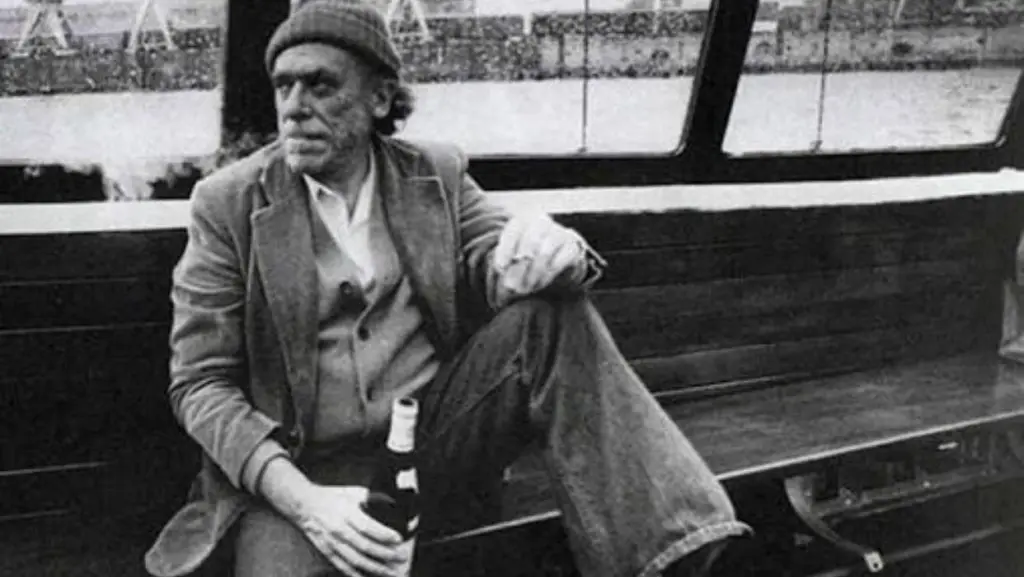
For people who haven’t read him, here is the rough sketch. Charles Bukowski was an American poet and novelist who worked at the Los Angeles post office for over a decade, drank prodigiously, wrote about cheap apartments and bad jobs and women who came and went, and somehow turned all of it into literature. His prose has the texture of a bar napkin and the precision of a stab wound. He wrote about a specifically American kind of failure. The dead-end day job. The Sunday afternoon spent waiting for nothing. The deep suspicion that the whole game was rigged, and the simultaneous refusal to stop playing it.
He should not, by any obvious logic, resonate in India.
We have our own literary tradition of suffering, with its own rich vocabulary. We have Manto. We have Premchand. We have Ismat Chughtai. We have the partition memoirs and the village ghazals and the Mumbai noir of Vikram Chandra. We have Shiv Kumar Batalvi turning heartbreak into something that bypasses your prefrontal cortex.
But Manto’s wounds are not my wounds. And the Mumbai noir is not my Mumbai. Indian literature, broadly speaking, has been very good at writing about poverty, partition, family drama, and the specifically post-colonial weight of being from here. It has not yet found the language for the middle-class tech worker’s particular brand of nothing.
That nothing is what Bukowski did best.
Think about the parallels for a second.
Bukowski worked at the post office. We work at Infosys, Accenture, some startup with a name that sounds like a misspelled verb. The work is technically prestigious. Your parents brag about it at weddings. But you, sitting in your cubicle in Embassy Tech Village, know that the actual work involves moving Jira tickets across columns and pretending to care in stand-ups about a product feature nobody asked for.
Bukowski drank because the days were long and the meaning was thin. We drink too. On Fridays at Toit. On Saturdays at someone’s apartment in Indiranagar where the speaker is just slightly too loud. The cocktails are more sophisticated now and the playlist is curated, but the underlying transaction is the same. You are paying a small fee to step outside your life for four hours.
Bukowski lived in boarding houses. We live in 1BHKs in tech corridors, paying half our salary to landlords who upgrade nothing and inspect everything. The boarding house and the PG have the same DNA. A place to keep your body while you go out and earn the money to keep your body.
Bukowski had women who came and went, and he wrote about them with a mixture of tenderness and cruelty that scandalized everyone. We have dating apps. The transactions are smoother, the language is more polite, but the loneliness on either side of the swipe is exactly the same loneliness.
But here is where it gets strange. Bukowski’s alienation came with time. He had long, empty hours to sit in his room and stare at the wall. He had the gift of bored Sunday afternoons. He could feel his life going wrong slowly, in a way that allowed him to write it down.
Our alienation comes with a calendar invite.
The Indian tech worker does not get long empty hours to sit with their own disappointment. They get back to back meetings, status reports, Slack notifications at 11pm because someone in California just woke up. They get a parents’ video call that has to be taken between a standup and a sprint review. The alienation has to be experienced in micro-doses. Between pings. In the eleven minutes the Ola is stuck at a signal.
This, I think, is why so few of us have written it down yet. Bukowski had emptiness as raw material. We have noise. You cannot easily write a poem about your spiritual condition when you also have to reply to a manager asking “quick sync?” on Slack.
And there is something else. Something harder.
Bukowski was allowed to fail. His America had a slot for him, the failed poet, the postman who drank. India does not yet have that slot. If you came to Bengaluru on a one-way train from a tier-2 town with a B.Tech and a suitcase, you are not allowed to fail. Your parents sold something to send you here. Your sister’s wedding is depending on your salary. The whole extended family system is leaning on the assumption that you are succeeding, and you cannot, you absolutely cannot, sit down and write a poem about how hollow it all feels. You have to keep it inside, where it slowly grows mold.
This is the new Indian sadness, and it has almost no literature yet.
I sometimes wonder if Bukowski would have survived Bengaluru. The man drank for fun, then for habit, then for survival. He needed long stretches of being unobserved. Bengaluru does not offer that. Your manager observes you. Your roommate observes you. Your mother observes you on every video call. The algorithms observe you for ad targeting. There is no quiet room to slowly disappear into.
Maybe that is why he hits so hard when you finally find him on a phone screen, stuck in traffic, while the meter runs.
He gives you permission to admit that the version of “success” you have been chasing might not actually deliver on its end of the deal. That the salary you keep negotiating up might not solve the thing it was supposed to solve. That the apartment you just signed the lease on, the car you are saving for, the marriage your family is already planning, might all be very nice and might still not touch the specific quiet ache that sits behind your sternum on Sunday evenings around 6pm.
He does not fix anything. He just tells you that you are not crazy. Other people have sat where you are sitting now, in a slightly different country, in a slightly different decade, and they too could not find the joy they had been promised.
That is not nothing. That is, in fact, what literature is for.
The traffic eventually moves. The cab eventually delivers me home. I close the app, plug in my phone, microwave dinner, lie down for tomorrow’s 9am call. Bukowski stays on the screen, dog-eared somewhere between a poem about birds and one about not giving up.
I do not know yet what the Indian Bukowski will sound like. I do not know if she will write in English or Kannada or some hybrid we have not invented yet. I do not know if he will be a tech worker or a delivery boy or a 38-year-old project manager who finally cracked one morning and started writing instead of joining the call.
But I know they are coming. The conditions are too perfect now. The cheap rooms exist. The bad coffee exists. The slow death of the salaried Indian promise is already underway, mostly unspoken, mostly endured behind ergonomic chairs in glass buildings off the airport road.
Someone is going to write it down.
And when they do, half of Bengaluru will quietly, secretly, recognize themselves on every page.